Radiations are dangerous, absolutely only the ionizing ones. Now what is this? Simple and easy, the enough energy to rip the electron of an atom is ionizing. This is measured in units called Sieverts. Now quick fact, if you are exposed to more than two Sieverts all at once probably you die shortly after that.
But..
We are exposed to the low levels of ionizing radiations all the time. Let’s take an example like banana. Who doesn’t love eating bananas? Everyone right?
Now listen, Banana are rich in potassium and some of that potassium is naturally radioactive. So, whenever you eat one banana you are surely exposed to (or eating) about 0.1 micro Sieverts of radiation. Simple that is 1/10,000,000th of Sieverts.
It seems very interesting like people eat bananas and actually them also become radioactive too. If you sleep next to someone you are actually more exposed than if you sleep alone, about 0.05 micro Sieverts.
I don’t think we should worry about that because that dose is very insignificant compared to the natural environment of the earth. I am talking about the ionizing radiations coming out of the soil, in the rocks, in the air, and even from the space.
The global average level of radiation is about 0.15 micro Sieverts per hour. These can be somewhere between the 0.1 to 0.2 micro Sieverts per hour. But there are some places that are higher than that. So who do you think receives the maximum dose of ionizing radiation on the earth?
Let’s answer that question by talking about the most radioactive places on earth.

Hiroshima, Japan
Some places you would expect to have the high levels of radiations might surprise you. Like Hiroshima, the first nuclear bomb was detonated over the city almost 78 years before. Now the level of radiations is only 0.3 micro Sieverts per hour.

Jachymov, Czech Republic
You probably never heard of this, because there is a mine where uranium was discovered. It is also the place where Marie Curie obtained the raw material. The level of ionizing radiations there is about 1.7 micro Sieverts which is the 10 times to the natural background that you have. Now a days, the most of uranium has been removed from the place, but still there are some small pieces and you can see them under UV light of fluoresces commonly known as Fluorescent uranium ore.

Radium Institute, Paris
Marie Curie was an amazing female. She won two Nobel prizes, one in physics and one in chemistry. She was in love of radioactive things. Apparently there are only a few parts of that area which are still radioactive. Like one of her doorknob, this is about 15 times of the normal background. That doorknob has almost 1.5 micro Sieverts.
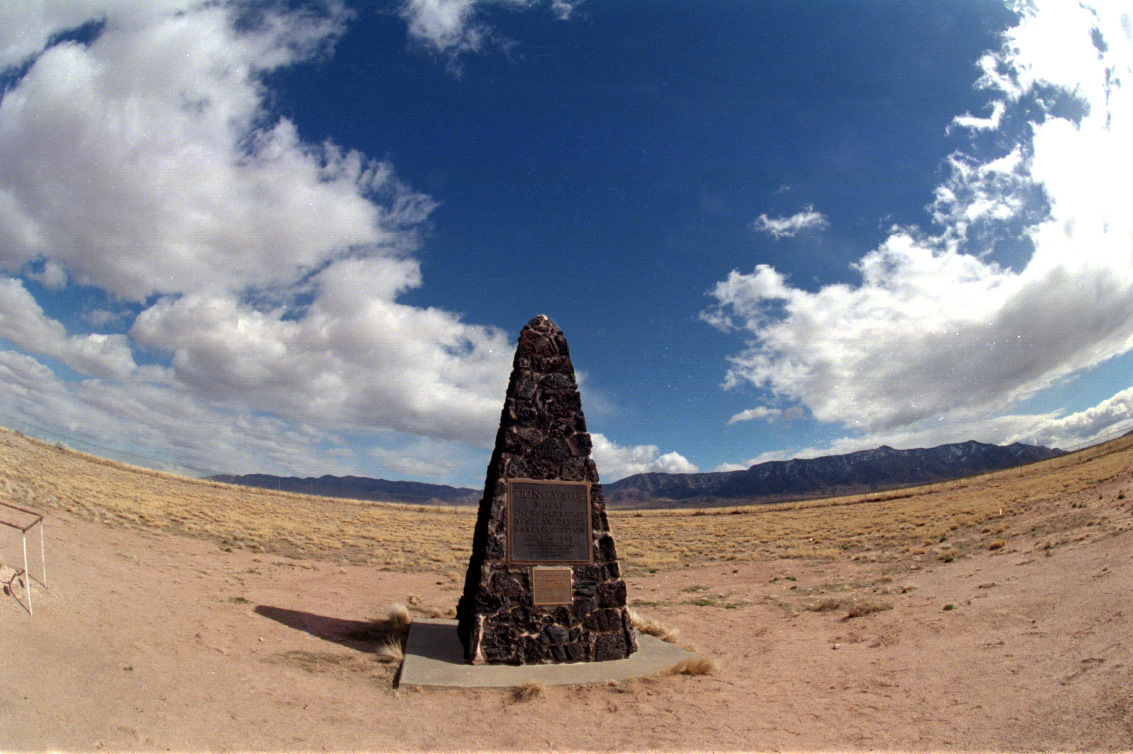
Trinity Site, New Mexico
Now I will welcome you to the Trinity bomb site, where the world’s first nuclear bomb was set off. This caused the whole area to vaporize. In fact, there was so much heat liberated by that bomb that it fussed all of the desert sand into green grass. And actually they have also named the mineral after the test called trinities’, which you can found at that place. Trinities’ are only made in history at only that place. The level of radiation there is about 0.8 micro Sieverts per hour. The level of radioactivity of the trinities is around 2.1 micro Sieverts.
Now which place has higher levels of radiation then anywhere we’ve seen so far?
The answer is airplane.
You will be surprised to see that as it gain altitude there is fewer atmospheres above you to shield you from cosmic rays. So the level of radiation inside the plane can go up to 0.5 micro Sieverts per hour at the 18,000 feet, up to one micro Sievert per hour at 23,000 feet, over 2 micro Sieverts per hour, and over 3 micro Sieverts per hour at even higher altitudes and towards to poles.

Chernobyl, Ukraine
In the Chernobyl nuclear reactor number 4, this was melted down on April 26, 1986. The incident happened because soo much heat was generated inside that reactor that it basically blew the top off, spreading radioactive isotopes throughout the whole surrounding area till Europe, Yu can still detect contamination there. That level reads about 5 micro Sieverts per hour. As you see that this is not the huge amount, this is because the administration there has removed the couple of meters of the topsoil from the whole area, then dumped it somewhere else.

Fukushima, Japan
In the Exclusion zone of the Fukushima, you would have to wear full safety gears. The leakage there was much less than Chernobyl by only 10% but that is much fresher than that. Same things were down here; I mean that they have removed the meters of topsoil from that area. The readings are up around 5 to 10 micro Sieverts per hour.

Pripyat Hospital, Ukraine
The Hospital where the firemen were taken after they fought the fires at the Chernobyl reactor. In the basement of that building, they have left all the firemen’s clothing once they realize that it was so contaminated. That pile of clothes is generating 500 micro Sieverts per hour from outside the closed room. And inside it rises up to 1500 micro Sieverts per hour. This place is the most radioactive place on the earth.
One hour in that basement is worth equal to the 1 year natural background radiation. Also consider that in a CT scan, the patient receives about 7,000 micro Sieverts, that is 3 years’ worth of natural background radiation. There is an estimate that people living around Fukushima will receive an additional 10,000 micro Sieverts over their lifetime due to the nuclear power disaster. For comparison, US radiation workers are limited to a maximum of 50,000 micro Sieverts pers year. But that is less than occupation. The Astronaut. Astronauts in the space station for six months will receive about 80,000 micro Sieverts worth of radiation. But not even they are exposed to the highest levels of ionizing radiations. So can you guess who is?
The answer is a smoker’s lungs. A smoker’s lungs on average receive 160,000 micro Sieverts worth of radiation every year. That is due to radioactive polonium and radioactive lead in the tobacco that they are smoking. So here, not only they are exposed to carcinogens and toxins they also receive high levels of radiation. So, it is not Fukushima people, radiation workers and not even the astronaut are getting highest levels of radiations on earth. That honor goes to your ordinary average smoker.